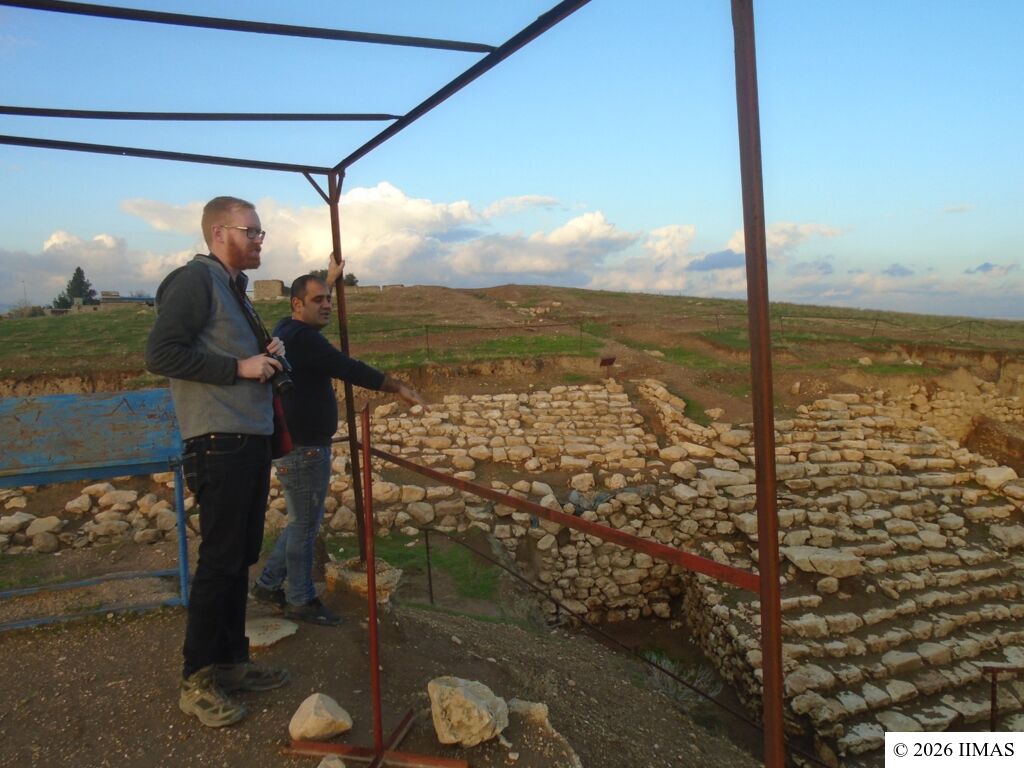
I accompanied Mr. Samuel Sweeney, an American freelance writer and researcher based in Erbil who holds a Master’s degree in Islamic-Christian relations from the University of Saint Joseph in Beirut. He had initially contacted me regarding a plan to visit several archaeological sites in the Raqqa province.
During our communications, I proposed that he include a visit to Tell Mozan (Urkesh) as well. He enthusiastically accepted, recognizing that a landmark site like Urkesh would serve as a robust and reliable example for an upcoming article. In this piece, to be written immediately upon his return, he intended to draw comparative insights between Urkesh and the other archaeological locales within the Raqqa province.
We toured the entire mound, discussing the rich history of the site alongside its most monumental architectural discoveries, such as the ābi, the Tupkish Palace, and the Great Temple. He was highly keen on photographically documenting every structural detail. Throughout the tour, he expressed deep admiration for the site and was remarkably impressed by the great dedication demonstrated by both the archaeological mission and the local community, who are preserving the site and its architectural features harmoniously.
Rather than speaking on his behalf, I would like to share the reflections he penned himself regarding his experience:
”It was a pleasure and an honor to visit the site of Tell Mozan (Urkesh) with Amer Ahmad. Having had the opportunity to visit other sites later on during my stay, the contrast between those and Tell Mozan became quite clear. The site is in excellent shape, and it is obvious how much those inside and outside Syria who have worked there care about it. Walking around Tell Mozan, the history of the site comes alive, and it provides an example of how to engage local communities with archaeology.
To anyone but a specialist, the importance of most archaeological sites remains abstract, but at Tell Mozan it is possible to walk around and grasp intuitively what the site would have felt like, and what its significance would have been at its peak. The area around Tell Mozan is very safe—there is no war zone or conflict to prevent a visit to the site or put it at risk.”
This is how the writer beautifully summarized his journey to Urkesh. He extended his sincere gratitude to all the dedicated staff maintaining the grounds, expressing his hope for a swift return of the archaeological mission to resume excavations and uncover deeper chapters of the city’s history.
Finally, I would like to express my deepest thanks to Mr. Sweeney for embracing my invitation to explore the wonders of Urkesh.
|
Back to top: Samuel Sweeney visiting Mozan